Help Centre +44 7853196056

Risk Management Strategies Every Forex Trader Should Know
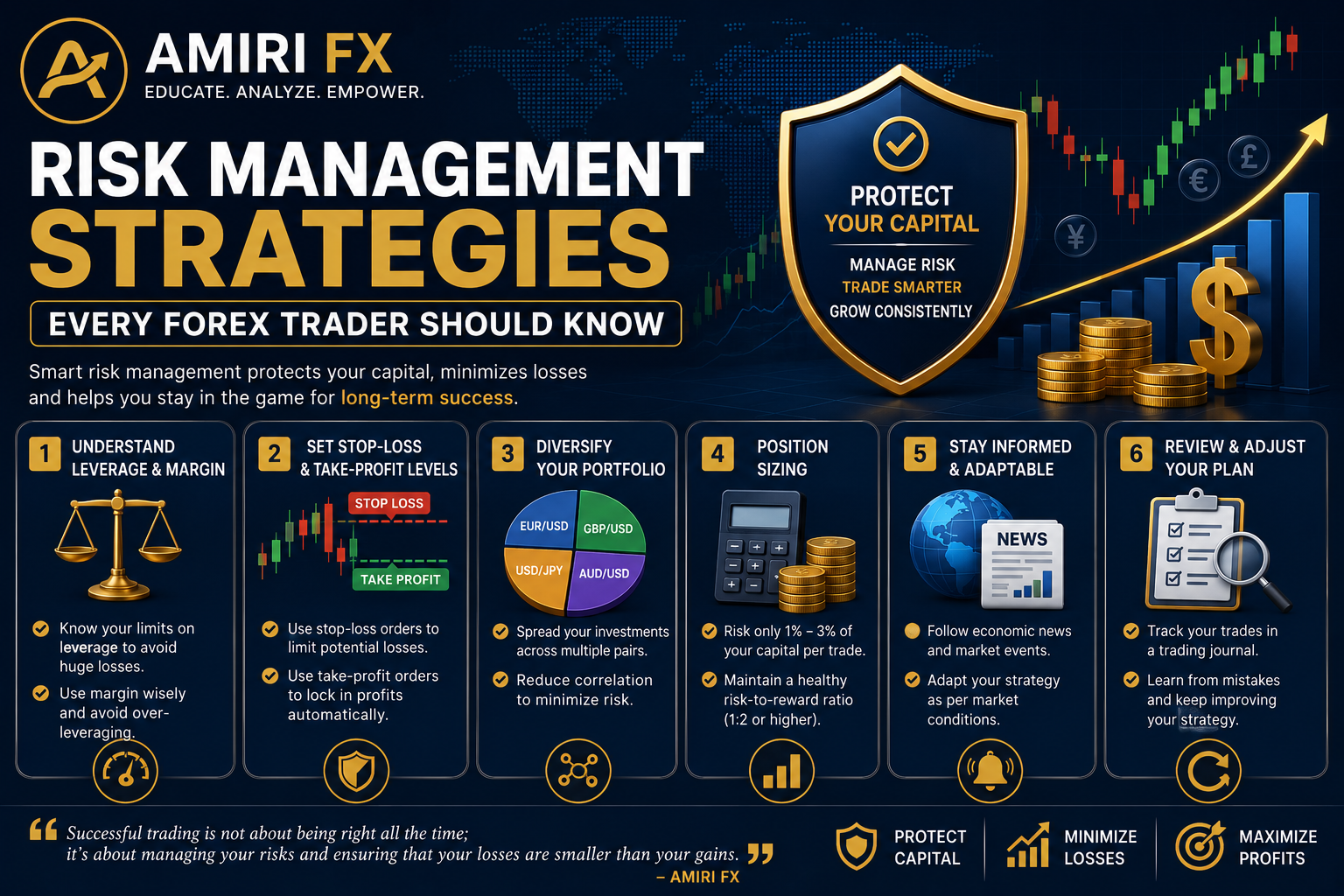
In the fast-paced world of forex trading, understanding and implementing effective risk management strategies is crucial for safeguarding your investments. At Amiri FX, we believe that a well-structured risk management plan can be the difference between a successful trading career and significant financial losses. In this blog post, we will explore essential risk management strategies that every forex trader should be aware of.
1. Understand Leverage and Margin
Leverage allows traders to control larger positions with a smaller amount of capital. While it can amplify profits, it also increases risk. Here’s what you need to keep in mind:
- Know Your Limits: Always be aware of how much leverage you are using. A higher leverage ratio can lead to larger losses.
- Use Margin Wisely: Ensure you have enough margin to sustain your positions. Avoid over-leveraging to prevent margin calls.
2. Set Stop-Loss and Take-Profit Levels
One of the most effective risk management techniques is to set stop-loss and take-profit levels before entering a trade. This helps to automate your exit strategy and protects your capital:
- Stop-Loss Orders: Place a stop-loss order to limit potential losses. This order automatically closes your position when the market reaches a specified price.
- Take-Profit Orders: Similarly, set a take-profit order to secure profits when the market price reaches your target level.
3. Diversify Your Portfolio
Diversification is a key principle in risk management. Instead of putting all your capital into one currency pair, consider spreading your investments across multiple pairs:
- Reduce Correlation: Choose currency pairs that do not move in tandem to minimize risk.
- Allocate Wisely: Determine the percentage of your total capital to allocate to each trade based on its risk profile.
4. Position Sizing
Position sizing is crucial for managing risk effectively. It involves determining the amount of capital to risk on a single trade:
- Fixed Fractional Method: Risk a fixed percentage of your trading capital on each trade, generally between 1% to 3%.
- Risk-to-Reward Ratio: Always evaluate the potential risk against the potential reward of each trade. A common ratio is 1:2 or higher.
5. Stay Informed and Adaptable
The forex market is influenced by numerous factors, including economic indicators and geopolitical events. Staying informed is vital:
- Follow Economic News: Keep track of key economic releases and market events that can impact currency prices.
- Adapt Your Strategy: Be prepared to adjust your trading strategies based on market conditions and new information.
6. Regularly Review and Adjust Your Trading Plan
Your trading plan should be a living document. Regularly review your performance and make adjustments as necessary:
- Track Your Trades: Maintain a trading journal to analyze your successes and failures.
- Learn from Mistakes: Use your reviews to identify patterns in your trading behavior and refine your strategies accordingly.
Conclusion
Implementing effective risk management strategies is essential for every forex trader. By understanding leverage, setting stop-loss and take-profit levels, diversifying your portfolio, managing position sizes, staying informed, and regularly reviewing your strategies, you can significantly improve your chances of long-term success in the forex market. At Amiri FX, we are committed to providing you with the tools and resources you need to manage risk effectively and enhance your trading experience.
"Successful trading is not about being right all the time; it's about managing your risks and ensuring that your losses are smaller than your gains." – Amiri FX